Buying Or Leasing A Company Vehicle In Canada
Contents
Share
Are you thinking of buying or leasing a vehicle for your business? There are several things to consider before making a decision. Each option has its benefits and drawbacks so the best option will depend on your priorities and circumstances.
Some questions you want to answer before buying or leasing a vehicle are:
- Is cash flow a concern?
- Will you put a lot of mileage on the car?
- How long are you planning to keep the car?
- How much personal driving are you planning to do?
Let's take a closer look at each option.
Buying A Car For Your Business
When you buy a car for your business, either by paying cash or financing it, the vehicle becomes a capital asset in your business and is amortized over its useful life.
A few things to think about when considering buying a car:
- Buying a car will cost more when comparing it to leasing over the same period, because the full cost of the vehicle is paid for.
- Financing a car usually results in higher monthly payments that will have a greater impact on your cash flow.
- Buying a car means you don't have to worry about limiting the kilometers you put on it or making modifications to the vehicle
- If you buy a car at the end of your fiscal year you'll be able to claim the same amount of amortization as you would if you bought it at the beginning of the year.
Passenger Vehicle vs Motor Vehicle
Depending on the vehicle you buy and the purpose it's used for, it may be classified as either a passenger vehicle or motor vehicle, which will affect amounts you can deduct.
CRA's vehicle definition chart below shows what each type of vehicle is classified as based on seating and business use. This helps to determine how the vehicle is amortized.
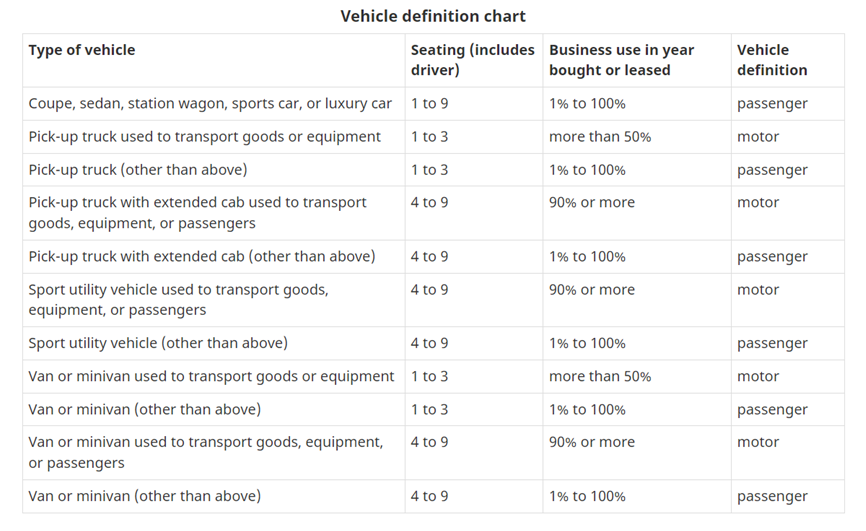
Check out CRA's type of vehicle page for more information on vehicle definitions.
Capital Cost Allowance (CCA)
Your vehicle is placed in either class 10, class 10.1, or class 54 or 55 if it's a zero emissions vehicle.
The CCA rate on a vehicle determines how much of the vehicle cost can be amortized each year.
Class 10
- Motor vehicles and some passenger vehicles are included in this class. Passenger vehicles that cost up to $34,000 are included in class 10.
- The CCA (Capital Cost Allowance) rate is 30% per year.
- For example, a vehicle costing $25,000 is recorded in class 10 at a cost of $28,000 ($25,000 + $1,250 GST + $1,750 PST). The CCA in the year the vehicle was purchased would be $4,200 ($28,000 x 30% x 50%) and would be expensed in year 1. Only half of the CCA rate is recorded in year 1 with the full 30% applied in the years following year 1. This means that the CCA on this vehicle is $4,200 regardless of whether it's purchased on January 1 or December 31.
Class 10.1
- Passenger vehicles costing more than $34,000 are recorded in this class.
- The CCA rate is 30% per year.
- Each passenger vehicle needs to be listed separately.
- For example, if a passenger vehicle costs $50,000, then CCA can only be claimed on $38,080 ($34,000 + $1,700 GST + 2,380 PST).
Class 54
- Zero emission motor and passenger vehicles costing up to $59,000 excluding taxicabs and vehicles that are used for lease and rent.
- The CCA rate is 30% per year.
Class 55
- Zero emission vehicles used as taxicabs and that are used for lease and rent.
- There is no ceiling on vehicle cost for class 54.
- The CCA rate is 40% per year.
In order to be eligible for class 54 or 55, the zero emissions vehicle you purchase needs to meet all of the following criteria:
- Your zero-emission vehicle needs to be purchased after March 18, 2019.
- You have not received an assistance under the federal purchasing incentive.
- Your zero-emission vehicle is essentially a motor vehicle for use on streets and highways.
- Your zero-emission vehicle is:
- A plug-in hybrid with at least a 7kWh battery capacity.
- An electric vehicle.
- A hydrogen powered vehicle.
For more information on CCA classes, check out CRA's classes of depreciable property page.
Interest
When financing a car, you can also claim the loan interest as an expense in your business. The maximum deduction on loan interest for a passenger vehicle is $300 per month.
Operating Costs
Operating costs related to the car such as fuel, insurance, and repairs and maintenance can be deducted each year the company owns the car.
GST ITCs (Input Tax Credits) On A Purchased Vehicle
A passenger vehicle purchased by a corporation can claim GST ITCs based on the following:
- A passenger vehicle purchased by a corporation can claim 100% of the GST ITCs on a maximum of $34,000 ($59,000 for qualifying zero-emission vehicles) if it is used for business purposes more than 50% of the time.
- If the passenger vehicle is used for business less than 50% of the time then no GST ITCs can be claimed on the purchase.
Sole Proprietor
GST ITCs are handled slightly different for vehicles bought by a sole proprietor.
- A passenger vehicle purchased by a sole proprietor must be used 90% or more of the time for business activities in order to claim 100% ITC.
- If vehicle usage for business activities is more than 10% but less than 90% then the GST ITCs are claimed at the end of each year and are based on the CCA taken on the vehicle for that year. For example, if you claim $5,000 in CCA on a vehicle for a fiscal year, your GST ITC for the year would be as follows: $5,000/105*5 = $238
- If the vehicle is used 10% or less for business activities, then no ITC can be claimed.
Leasing A Car For Your Business
When you lease a car you record your monthly payments as an expense each month, the car does not get included as a capital asset.
The limit on lease costs is $900 plus GST/PST or HST per month and is pro rated if value of the car is more than $34,000.
There are a few things to take into consideration when leasing a car:
- If you make a down payment at the beginning of your lease, the down payment is prorated over the life of the lease and added to the leasing cost. For passenger vehicles there must still be room to claim it so the total lease cost per month doesn't exceed $900 per month.
- Monthly lease payments tend to be lower than monthly financing payments resulting in improved cash flow. However, at the end of the lease, you will have to decide whether to buy out the vehicle or return it and lease a new car.
- Leases tend to have a limit on the kilometers the vehicle can be driven each year, so if you do a lot of driving for business you'll have to pay a penalty for any excess kilometers driven.
- The timing of a lease is important to consider as it can affect the amount you can deduct in the year. Unlike buying a car where you can claim the same amount of CCA regardless of when the vehicle was bought, you can only claim the amount of the lease payments paid during the year. This means leasing a car at the end of the fiscal year could result in no deduction for the year if the first lease payment isn't until the following month. So it's more beneficial to lease a car earlier in the year.
Operating Costs
Operating costs can also be deducted for leased cars. This includes vehicle insurance, fuel, and repairs and maintenance.
GST ITCs On A Leased Car
When you lease a car, the GST is included in the monthly payments and are recorded as ITCs each month you make a lease payment. However, if the lease payments exceed the maximum lease amount, any GST ITCs on the excess lease amount is recaptured and added to the net tax on the first GST return following the taxation year.
Personal Use Of A Car You Buy Or Lease
You should also consider the amount of personal driving the employee or owner-manager will be doing.
If there is any personal driving done in a business car, then the employee will receive a taxable benefit that will be added to their T4 at the end of the year.
The taxable benefit can be quite significant especially if the employee uses the vehicle for personal use more than 50% of the time.
Take a look at our taxable benefits blog to find out how benefits for personal car use are calculated.
Buying Or Leasing A Car Personally
If you are considering buying or leasing a car in your company but will use it personally more than 50% of the time, it's worth considering buying or leasing the vehicle personally.
By buying or leasing a car personally, the company can pay you a reasonable allowance, which is not a taxable benefit, for the business use of your car.
For 2022 the reasonable allowance stated by CRA is $0.61 per km for the first 5,000 km and $0.55 after 5,000 km. The Northwest Territories, Yukon, and Nunavut allow an addition $0.04 per kilometer. If a total of 20,000 km are put on a car in a year and business use was 8,000 km, you would receive a non-taxable allowance from the company for:
($0.61 x 5,000) + ($0.55 x 3,000) = $6,050.55
Mileage Tracking
In order to track business and personal kilometers it's best to use a logbook to track each trip, the date of the trip, the reason for the trip, and the kilometers driven for each trip. It's also important to note the odometer reading at the start and end of the fiscal year.
There are also various apps that can track the mileage of each business vehicle.
The following are some options you can use:
- Triplog
- Quickbooks
- mileIQ
- Hurdlr
- Everlance
Summary
Buying a car means you have the freedom to drive as much as you want without incurring mileage penalties, you can modify the car, and if you finance it, you own it at the end of the finance period. However, financing does typically come with higher monthly payments which will affect your cash flow.
Leasing a car gives you lower monthly payments that are less of a burden on cash flow. If you prefer driving a new car every few years, a lease may be for you since you can return the car at the end of the lease and go lease a new model.
However, leases limit the kilometers driven and can lead to costly penalties if you exceed the limit. Leased cars also need to be returned in the same condition as when they were new, so if you want to modify your car to carry out your business operations, then leasing may not be the best option. If you're considering making a down payment, make sure you have room to claim each month, as it's prorated over the life of the lease.
When deciding whether leasing or buying a car is right for you, you need to consider the financial costs, the allowable tax deductions, and how you will use the car in order to conclude which option is best for your situation.
Visit our corporate accounting services and plans pages to learn more about how we can assist you in reaching your goals. They provide an overview of our services, including information on the benefits and features of each. Feel free to contact us if you have any questions about our services.
Disclaimer
The author takes reasonable care to make sure the information on this blog is complete at the time it was posted. The information may not be comprehensive or current and is provided for general information purposes only.
This blog is not meant to be used as an alternative to professional advice. You should always consult with a professional to obtain advice on your specific situation.