Dividends vs. Salary – What’s The Best Way To Pay Yourself As A Business Owner?

Contents
Share
How To Decide Between Dividends vs. Salary?
As a business owner, determining which option is the most beneficial can be difficult when deciding between dividends vs. salary. Both have pros and cons, so ensuring the chosen option has the characteristics needed to meet the shareholder’s needs is essential. This article will look at both options to determine the best fit.
What Are Dividends?
Dividends are a distribution of a portion of the company’s after-tax earnings to its shareholders. Typically, the shareholder will transfer cash from the company to their personal bank account during the year. They then receive a T5 slip at the end of the year to report the dividend income on their individual tax return.
Advantages Of Paying Dividends
Less Administrative Work
By taking dividends, the corporation doesn’t have to worry about setting up a payroll account or remitting source deductions.
When a shareholder takes dividends, the corporation must file a T5 and a dividend resolution in their corporate minute book.
This simplicity can be especially beneficial for smaller corporations, where the shareholder would be the only employee.
CPP Doesn’t Get Paid On Dividends
Dividends don’t require CPP deductions, which will lower corporate expenses and personal costs.
No Source Deductions
The corporation doesn’t have to worry about penalties and interest from filing late source deductions that it would be subject to if it made late source deductions on salary.
Minimize Employer Health Tax (EHT)
EHT premiums can be reduced if the corporation has payroll over $500,000, as the calculation of EHT premiums excludes dividends.
Advantages Of Paying Dividends
Dividends Aren’t A Business Expense
Dividends are paid after tax by your corporation, so they aren’t considered an expense by your company, resulting in higher corporate taxes.
No CPP Contributions
Dividends do not qualify for CPP contributions. This means that shareholders won’t accumulate CPP benefits, which can affect their retirement income.
RRSP Room Doesn’t Grow
Dividends do not create RRSP contribution room. If you have RRSP contribution room, then you can still use it even if you received dividends from your company, but dividends won’t increase the amount each year. This means that you may need to plan a non-RRSP retirement savings strategy.
Surprise Tax Bill
As tax isn’t withheld on dividends, shareholders are more likely to receive a surprise tax bill for their personal taxes at the end of the year. They may also be required to pay instalments to CRA. If their net tax owing is over $3,000 for the current year or the previous 2 years, they may be required to make quarterly instalments (March 15, June 15, September 15, and December 15) to the CRA.
May Not Be Able To Claim Some Expenses
If a shareholder only receives dividends, they won’t be able to deduct child care expenses or moving expenses on their personal income tax return as dividends are not considered earned income. In addition, dividends don’t qualify for the Canada workers benefit, so if the shareholder has low income and takes only dividends, they won’t be eligible.
Other Things To Consider With Dividends
If a shareholder takes dividends from their corporation, there are a few things to be aware of.
Share classes
Something to consider when paying dividends is that they are paid based on the number of shares a shareholder owns. If multiple shareholders own the same class, they must be paid the same amount per share.
If two shareholders each own 100 class A shares of a company and one shareholder wants a $100,000 dividend, the other shareholder must also take a $100,000 dividend. This is because for the first shareholder to receive a $100,000 dividend, there must be a dividend of $1,000 per share ($1,000 x 100 shares = $ 100,000). This means that all class A shares have to be issued a $1,000 per share dividend, resulting in the second shareholder receiving a $100,000 dividend as well.
This could cause issues as each shareholder may have different circumstances where dividends may not be optimal for one of them.
Insolvency
There are also sections in the Business Corporations Act that prohibit dividends from being paid if the company is insolvent or would become insolvent if a dividend was paid.
Dividend Gross-Up Amount (Taxable Amount)
Suppose a shareholder collects old age security (OAS). In that case, they should be aware that the grossed-up amount of their dividends, not the actual amount, is considered when determining if their income has exceeded the OAS clawback amount of $81,761 for 2022.
Corporate Liabilities
Suppose a shareholder received a dividend during the same time their company owed the CRA GST, corporate tax, or source deductions. In that case, the CRA can collect the amounts owing from the shareholder if the company doesn’t have the money to pay the CRA (ITA 160).
What Is A Salary?
A salary is a fixed, regular payment typically paid monthly or bi-weekly. The shareholder is paid as an employee of the corporation, with income tax and Canada pension plan (CPP) being withheld each pay period and remitted to the CRA by the company. At the end of the year, the shareholder will receive a T4 slip to report their employment income on their personal tax return.
The CRA has a payroll calculator that can be used to calculate payroll remittances for each payroll period.
Advantages Of Paying A Salary
It’s A Business Expense
A salary paid to you is a business expense to your corporation and will result in lower corporate taxes. A salary is also helpful in reducing the corporation’s net income to below the $500,000 small business deduction to prevent paying a higher corporate tax rate.
A Salary Creates RRSP Contribution Room
A salary is considered earned income and helps to build RRSP contribution room. This allows the shareholder to contribute to their RRSP and helps to defer taxes until they retire and are in a lower tax bracket.
The maximum RRSP contribution for 2022 is $29,210 ($162,278 x 18%).
Contribute To The Canada Pension Plan (CPP)
Salary earnings contribute to CPP as long as the shareholder’s salary is more than $3,500. This means that CPP contributions will be withheld from their pay each pay period and remitted to the Canada Revenue Agency (CRA). In addition, if their salary exceeds the CPP disability basic exemption ($6,400 in 2022), it will count as a contributory year toward their eligibility for CPP disability benefits.
Avoid Surprise Tax Bills
Taxes on salary are withheld throughout the year, which helps prevent a large tax bill at the end of the year.
Viewed Favorably By Banks For Borrowing
Banks view a salary as a consistent and predictable form of remuneration, so if a shareholder is looking to get a mortgage, a salary may be the preferred form of compensation.
Qualify For Government Subsidies And Tax Credits
A salary is considered earned income, so child care expenses and moving expenses can be deducted from a shareholder’s salary on their personal income tax return.
If a business pays a small salary to the shareholder, the shareholder could be eligible to receive the Canada workers benefit. Find out about the eligibility for the Canada workers benefit.
Disadvantages Of Paying A Salary
Increased Administrative Burden
There is a lot of work involved with preparing payroll. Paying a salary involves:
- Setting up and managing a payroll system.
- Making payroll remittances to the CRA throughout the year.
- Preparing and filing a T4 slip.
CPP Costs
CPP deductions are mandatory when paying a salary. Paying a salary requires the company to withhold CPP from the employee’s salary and make an equal CPP contribution from the employer. So, instead of remitting 5.70% CPP, the company has to remit 11.40% of the employee’s salary.
Increased EHT Costs
If a shareholder has a high salary or the company already has employees receiving salaries, the addition of a shareholder’s salary can create or increase the EHT premiums for the company.
Comparing Both Options
Let’s look at an example where a salary is paid and one where dividends are paid to the owner-manager. The comparisons below only consider the cost of dividends vs. salary options. It does not consider the other advantages and disadvantages of each option that would have to be considered on a case-by-case basis.
The examples use the corporate and personal tax rates for British Columbia. We also assume the owner-manager has no other income reported on their individual tax return.
Results could vary by province due to different corporate and personal tax rates.
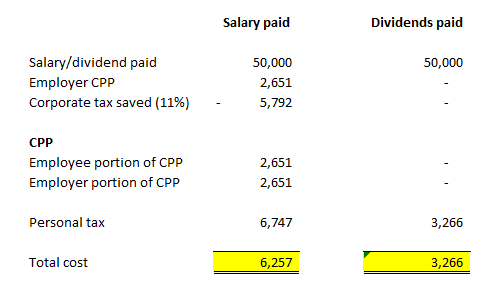
$50,000 In Dividends vs. Salary
When comparing $50,000 in dividends vs. salary being paid, we see that:
- The shareholder pays $3,481 less personal tax for dividends.
- Dividends cost $2,991 less overall.
$125,000 In Dividends vs. Salary
When comparing $125,000 in dividends vs. salary being paid, we see that:
- The shareholder pays $7,177 less personal tax for dividends.
- Dividends cost $42 less overall.
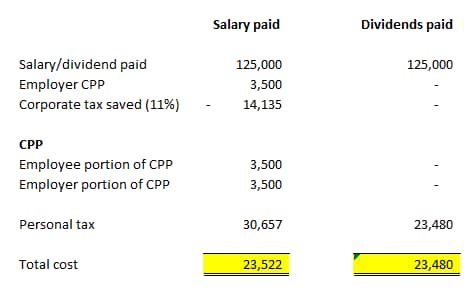
As the salary option increases, the corporation saves money by deducting salary and CPP expenses.
$200,000 In Dividends vs. Salary
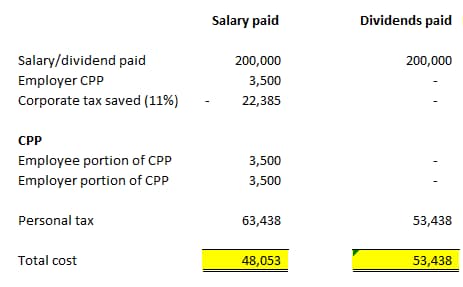
When comparing $200,000 in dividends vs. salary being paid, we see that:
- The shareholder pays $10,000 less personal tax for dividends.
- Salary costs $5,385 less overall.
Dividends vs. Salary – Which One To Choose?
As you can see in the chart below, as the dividend or salary increases, the cost of salary becomes less than the cost of the dividends.
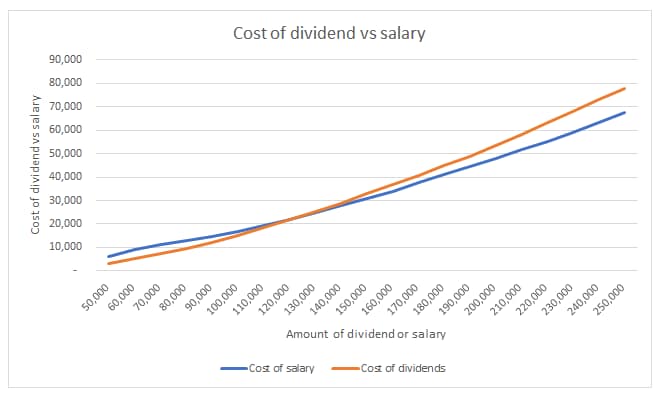
However, as this is a simplified example, the actual decision may not be as clear-cut as each option has different benefits and drawbacks. It’s important to consider the circumstances of the corporation and the individual shareholder to determine which method of remuneration will provide the desired results.
Other Options
Shareholder Loan
If the shareholder loan has a credit balance, it means the shareholder has put more cash into your business than they have taken out. It also means they can take that cash from the company tax-free since the personal tax has already been paid. So, if there is a shareholder loan credit balance, the shareholder may want to take a portion of their compensation out tax-free and take the rest as dividends or salary.
Eligible Dividends
Corporations can pay eligible dividends with earnings above the $500,000 small business deduction. Income that exceeds the small business deduction is taxed at a higher rate and is tracked in the corporation’s general rate income pool (GRIP) balance.
If a corporation has a GRIP balance, then dividends up to the amount of the GRIP balance can be designated as eligible dividends. Eligible dividends receive better tax treatment than non-eligible dividends since the corporate tax was paid at a higher rate on the income used to pay out the eligible dividends.
To learn more about the differences between these dividends, check out our blog post about the differences between eligible and non-eligible dividends.
Capital Dividends
The capital dividend account (CDA) is made up of several sources, but if there is a balance in your CDA account, it can be paid out tax-free to you.
To pay a capital dividend, the following documents need to be filed with the CRA:
- Schedule 89 – The CDA balance is calculated on this form and is submitted to CRA to verify the CDA balance.
- Form T2054 – This form must be completed and filed with the CRA to elect for the capital dividend to be paid.
- A certified copy of the directors resolution to pay a capital dividend needs to be submitted with form T2054.
Paying Salaries or Dividends To Family Members
Salaries and dividends can be paid to family members, but shareholders should be aware of some rules around paying them.
Paying Salaries To Family Members
Pay a reasonable amount: When hiring a family member, viewing them as an arm’s length employee is essential. This means paying them a salary similar to what you would pay an arm’s length employee. For example, if a shareholder were to pay their spouse $80,000 for a position that they would pay $40,000 to an arm’s length employee, then CRA could deny a portion of the wage expense. This could also result in double taxation if the corporation is denied the expense, but the family member still needs to report the full salary.
They need to be doing work for the business. If the company pays a salary to a family member of the shareholder, they must be actually doing work for the business. Job descriptions should be prepared, timesheets filled out by family members, and any other documents that an arm’s length employee would need to complete. This is because if CRA asks about salary expenses, the business will need to provide documentation supporting the work that family members are doing in exchange for the salary paid to them.
Salary payments need to actually be deposited in the family member’s bank account. The CRA will want to see the paper trail of the payment from the business to the family member’s bank account. If the payment is never actually made to the family member and the funds remain in the business account, then the business is at risk of the CRA denying the salary expense should they ever investigate the expense accounts.
Paying Dividends To Family Members
To pay dividends to family members, they need to be shareholders of the business. In 2018, tax on split income (TOSI) rules came into effect, making it more difficult to pay dividends to family members of the shareholder.
TOSI rules result in dividends paid to family members being taxed at the highest marginal tax rate (53.50% in BC in 2022).
However, some exceptions exist where dividends can be paid to family members without being subject to the highest marginal tax rate. A couple of common exceptions are:
- When a family member is actively involved in the business on a regular, continuous, and substantial basis for an average of 20 hours per week during the fiscal year or any of the 5 previous fiscal years.
- TOSI will not apply when amounts are paid to the business owner’s spouse, as long as the business owner turns 65 during the year, and the amount would have been excluded from TOSI if it was received directly by the business owner.
Conclusion
When deciding to go with dividends vs. salary, there is no clear answer as to which option is better. There are several factors to consider before deciding on dividends or salary.
It’s important to consider the tax cost of each option as it will determine how much money will end up in the shareholder’s pocket. The combination of the tax paid by the corporation and the shareholder can help identify the option that is taxed the least.
However, it is also important to consider the advantages and disadvantages of each option as it relates to the shareholder’s personal tax situation. The decision can affect the shareholder’s personal tax strategy and retirement planning.
Ultimately, when choosing between dividends or salary, the decision will depend on multiple factors that depend on the shareholder’s particular situation, not just the amount of tax that will be paid.
Visit our payroll services and plans pages to learn more about how we can assist you in reaching your goals. They provide an overview of our services, including information on the benefits and features of each. Feel free to contact us if you have any questions about our services.
Disclaimer
The author takes reasonable care to ensure the information on this blog is complete at the time it was posted. The information may not be comprehensive or current and is only provided for general information purposes.
This blog is not meant to be an alternative to professional advice. You should always consult a professional to obtain advice on your situation.