Income Statement 101: Everything You Need to Know

Contents
Share
What is an income statement?
An income statement, also known as a profit and loss statement (P&L) or statement of operations, is a financial document showing a company’s revenues and expenses over a specific period, such as a month, quarter, or year. The income statement, balance sheet, and cash flow statement make up a company’s primary financial statement documents.
An income statement’s purpose is to provide an overview of a company’s financial performance by displaying how much revenue was generated, what costs were incurred, and what the net income or loss was for the period. It is one of management’s most critical financial statements to understand a company’s financial performance and position.
The importance of an income statement
As a business owner, it’s important that you are familiar with the information the income statement provides you.
The income statement provides valuable information that can be used to create budgets and forecasts. The current period can be compared to prior periods to see where improvements have been made or need to be made.
The income statement provides plenty of important information about your business that can help you make better decisions, such as:
- Ratios like the gross profit margin, operating margin, net profit margin, return on assets (ROA), and return on equity (ROE) can be calculated to assess the performance of the business.
- You can compare the results of the income statement to prior periods which lets you see if your business is moving in the right direction. By looking at the income statement monthly or quarterly, you can identify any issues or opportunities to make better decisions.
- You can see the profitability of your company for a specific period.
- The income statement can be used to create budgets and compare it to the current period budget to see if any areas are over or under budget.
- If your business ever needs a loan, the income statement will be one of the financial statements lenders want to see.
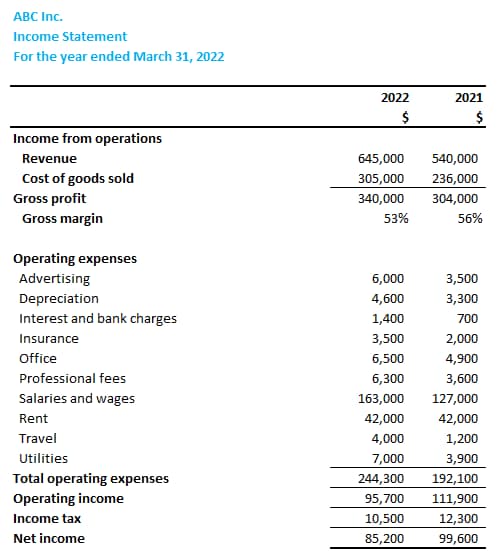
Sample income statement
What are the components of the income statement?
Revenue
The income generated by a company’s operations is referred to as revenue. On an income statement, it is usually the most important item. It represents the total amount of money earned by the company during a given time period, such as a month, quarter, or year.
There are various types of revenue depending on the nature of a company’s business.
- Sales revenue: money earned from the sale of goods or services is one of the most common types of revenue.
- Interest revenue: interest earned on investments or loans;
- Rental revenue: income earned from the rental of property or equipment; and
- Royalty revenue: income earned from using a company’s intellectual property.
Revenue is a top-line or gross income item that represents the money that enters a company prior to deducting any costs. It is the basis for calculating gross profit and net income.
It’s important to remember that external factors like the economy, industry trends, and competition can all have an impact on revenue. Investors and lenders prefer companies with a consistent and growing revenue stream.
Cost of goods sold
Cost of goods sold (COGS) measures the direct costs related to producing and selling a product.
COGS includes all the direct costs of producing a product or providing a service, such as:
- Raw materials and supplies
- Labor costs directly tied to production
- Manufacturing overhead
- Shipping and handling costs for goods sold
COGS doesn’t include indirect administrative, selling, or general expenses.
Understanding and managing COGS is important for a company to maintain profitability and make informed pricing decisions. It also helps management to identify the most efficient production methods and cost-saving opportunities. Furthermore, it can give an idea about the company’s efficiency in utilizing its resources.
Gross profit
Gross profit, also known as gross margin, represents the amount of money a company earns from its core operations before deducting indirect expenses such as administrative, selling, and general expenses. It is calculated by deducting COGS from revenue.
Gross profit is important for determining a company’s profitability and efficiency. It’s the money left over after a company has paid for the direct costs of producing and selling its products or services. A higher gross profit margin generally indicates that a company is more efficient in cost management and product pricing.
Operating expenses
Operating expenses are the costs a company incurs to run its business, but they are not directly tied to producing and selling a product or service. These are also known as indirect expenses or SG&A (selling, general, and administrative expenses).
Examples of operating expenses include:
- Salaries and wages for non-production employees
- Rent and utilities for office or warehouse space
- Marketing and advertising costs
- Legal and accounting fees
- Insurance
Operating income
Operating income is a company’s profit from its core operations before accounting for interest and taxes. It is calculated by subtracting operating expenses from gross profit.
Non-operating income and expenses
Non-operating income and expenses are revenues or costs that aren’t directly related to a company’s core operations. They are also referred to as “other income” or “other expenses” and can include items like:
- Interest income or expense: income or costs associated with borrowing or lending money
- Dividend income: income from investments in other companies
- Gains or losses from the sale of assets: such as investments or property
- Foreign currency gains or losses: resulting from changes in exchange rates
Net income
Net income, also known as net profit or net earnings, is the bottom line on an income statement and represents the profit or loss for a specific period, such as a month, quarter, or year. It’s calculated by subtracting all expenses, COGS, operating expenses, and non-operating expenses from revenue.
How to analyze the different components of the income statement
Using ratios
Assessing the efficiency and profitability of a company’s operations is an important step in determining its overall financial health. When evaluating the efficiency and profitability of a company’s operations, consider the following key metrics:
Gross Profit Margin: Calculated by dividing gross profit by revenue, this metric shows how much profit the company makes from its core operations before accounting for indirect expenses. A higher gross profit margin generally indicates that a company is more efficient in cost management and product pricing.

ROI (Return on Assets): It is calculated by dividing net income by total assets; it measures a company’s profitability by taking into account both income and the assets required to generate that income. A higher return on assets generally indicates that a company is more efficient in profitably utilizing its assets.

Return on Equity (ROE): It is calculated by dividing net income by shareholder’s equity; it measures how well a company generates a return for its shareholders. A higher return on equity generally indicates that a company is more efficient in utilizing its shareholder’s investments to generate a profit.

Overall, analyzing these key metrics can provide valuable insight into the efficiency and profitability of a company’s operations.
Identifying trends and patterns over time
By looking at a company’s financial performance over several periods, business owners can identify trends and patterns that can provide insight into the company’s overall financial performance and position.
Here are a few key steps to take when identifying trends and patterns over time:
- Look for changes in revenue: Compare the revenue for the current period to the previous periods. Look for any changes in revenue and try to understand the underlying causes. This can help to identify opportunities for growing revenue or issues of declining revenue that need to be explained and addressed.
- Analyze expenses: Compare the costs of goods sold, operating expenses, and non-operating income and expenses over time. Looking at each line item can help to identify large changes in expenses from prior periods where action may need to be taken to get them back in line.
- Identify seasonality: Some companies may have seasonal fluctuations, such as retailers during the Christmas season or service companies during summer. Take into consideration the seasonality when analyzing the trends.
- Compare to industry averages: Compare the company’s financial performance to industry averages to see if the company is performing better or worse than its peers.
By identifying trends and patterns over time, investors and analysts can better understand a company’s financial performance and position. It also helps to identify areas of strength and weakness and potential opportunities for improvement.
Summary
For business financial planning, an income statement is a crucial tool for evaluating a company’s financial performance and position. By analyzing an income statement, business owners and managers can identify areas of strength and weakness in their operations and make informed decisions to improve the company’s financial performance. This includes identifying areas of cost savings, increasing revenue, and improving efficiency.
Furthermore, understanding and analyzing the income statement can help forecast the business’s future performance; this can help the management create a budget, set goals, and make strategic decisions. It can also help identify potential opportunities and threats and assess the company’s ability to generate cash flow and pay dividends.
Visit our corporate accounting services and plans pages to learn more about how we can assist you in reaching your goals. They provide an overview of our services, including information on the benefits and features of each. Feel free to contact us if you have any questions about our services.