Use The GST/HST Quick Method To Save Tax And Time

Contents
Share
The GST/HST quick method is an alternative to the GST/HST regular method of filing that is meant to simplify the GST/HST calculation for small businesses. It may also result in lower GST/HST owing for some businesses.
Let’s take a closer look at how the quick method works.
Quick Method Of Accounting For Calculating GST/HST
In order to use the quick method of accounting to calculate your GST/HST, you must first file an election with the CRA. You must use the quick method of accounting for at least one year before you can file an election to revoke using the quick method of accounting.
You can file the election using the following methods:
- through your my business account
- a representative can file it using the represent a client account.
- You can complete form GST74 and mail it to your tax services office.
You can also elect to revoke using the quick method of accounting using the methods above. However, if you want to elect to use the quick method of accounting after revoking it, you must wait at least one year from the date it was revoked to elect to use the quick method of accounting again.
The requirements for using the quick method of accounting are:
- You were continuously in business for 365 days prior to the current reporting period.
- You did not revoke an election to use the quick method or simplified method for claiming ITCs in the 365 days prior to the current reporting period.
- Annual worldwide taxable supplies cannot be more than $400,000 including GST/HST in four consecutive quarters in the last five quarters.
- The following are not part of the $400,000 limit:
- Goodwill
- Sale of real property
- Sale of capital assets
- Sale of financial services
New registrants – If you are a new registrant and were not continuously in business for the past 365 days you may still be eligible to use the quick method of accounting. You can elect to use the quick method if you expect that your worldwide revenues will be less than $400,000.
Businesses That Are Not Eligible To Use The Quick Method
The following types of businesses cannot elect to use the quick method of accounting for GST:
- Persons that provide legal, accounting, and actuarial services in the course of their professional practice
- Persons that provide bookkeeping, financial consulting, tax consulting, or tax return preparation services in the course of their commercial activities
- Listed financial institutions
- Public institutions
- Municipalities or local authorities designated as municipalities
- Public colleges, school authorities, or universities, that are established and operating other than for profit
- Hospital authorities, facility operators, or external suppliers
- Charities
- Non-profit organizations with at least 40% government funding in the year
There is a special quick method of accounting for public services bodies, click here to find out more.
How The Quick Method Works
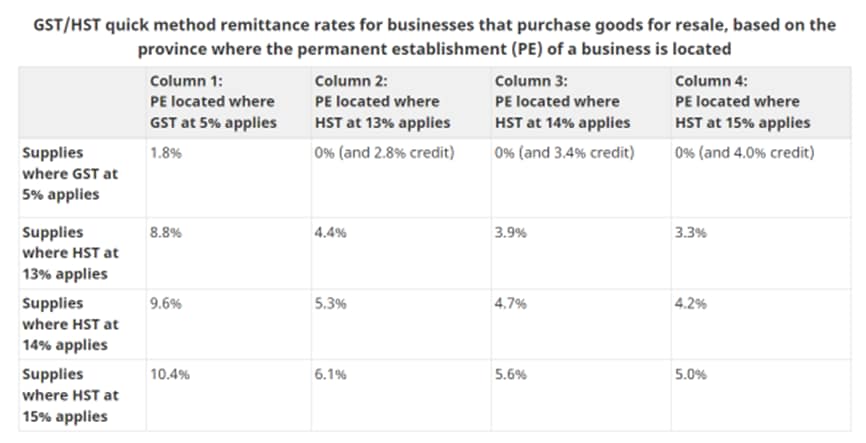
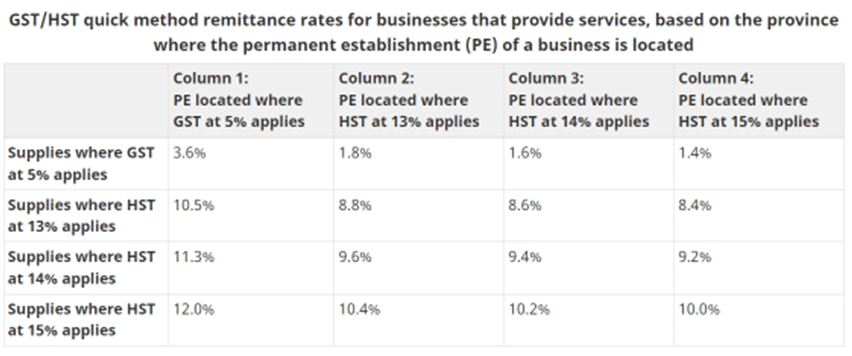
When you use the quick method of accounting for GST/HST, you collect GST/HST the same as you normally would. However, the remittance amount is calculated using the full amount of revenue plus GST/HST on taxable supplies and multiplied by the corresponding remittance rate from the charts below.
When you file your GST/HST return using the quick method of accounting, you still use the same GST/HST return form as you would for the regular method. You still need to keep all receipts related to business purchases for 7 years in case CRA requests them.
There are a few types of operating expenses that you can claim input tax credits (ITCs) on, even if you have elected to use the quick method.
You can claim ITCs on the following expenses:
- If you purchase real property or make improvements to real property
- Purchases of capital property
- Purchases or eligible capital property
- Purchases where the GST/HST was paid before your election to use the quick method took effect
- Goods that were sold for by an auctioneer or agent and they had to account for the tax
- Goods purchased for the sole purpose of business use if both the following criteria are met:
- A non-resident, who is not registered for the GST/HST, transferred them to you, after paying the tax on them
- You provided a commercial service on the goods and then sold them, acting as an agent for the non-resident and collecting the GST/HST
Provincial GST/HST Rates
Although these rates aren’t directly used to calculate GST using the quick method, they are used to determine the remittance rate from the charts below.
Remittance Rates For The Quick Method Of Accounting
The remittance rates for the quick method of accounting vary depending on the following:
- Whether the business sells goods or services
- The GST/HST rate based on the permanent establishment of the business
If you own a business that purchases goods for resale, you will use chart 1. In order to be able to use the rates in chart 1, the goods you purchased in the prior year to either sell or use in manufacturing products to sell needs to be at least 40% of the total revenue from taxable supplies in the prior year.
For example, if your annual taxable supplies (including GST/HST) were $150,000 and the goods purchased in the prior year were $60,000, you would be eligible to use the remittance rates in chart 1 since the percentage of purchases to sales is 40% ($60,000/$150,000). However, if your goods purchased in the prior year were less than $60,000, you would not be eligible to use the remittance rates in chart 1 and would need to use the remittance rates in chart 2 to calculate your GST/HST.
What If You Make Supplies In Both Participating (HST) And Non-Participating (GST) Provinces?
Normally, you would need to use more than one remittance rate to determine your GST if you make supplies in both participating and non-participating provinces.
However, the following rules apply if you make 90% or more supplies in either a participating or non-participating province:
- If 90% or more of your supplies were made through a permanent establishment in a participating province, then use that rate for all of your supplies in that period.
- If 90% or more of your supplies were made through a permanent establishment in a non-participating province, then use that rate for all of your supplies in that period.
1% Credit On Eligible Supplies
If you use the quick method of accounting for your GST/HST, you’re able to receive a 1% credit on the first $30,000 of eligible supplies (including GST or HST) in each fiscal year.
To be eligible for the credit, your election to use the quick method must have been in effect at the start of the fiscal year. If you are a new registrant, then you qualify the day you became a registrant.
If you qualify for a 0% remittance rate (GST columns 2, 3, or 4 in chart 1) you are still eligible for the 1% credit in addition to the credit noted in each column.
If you do not have $30,000 in eligible supplies for the fiscal year, you are not allowed to carry forward any unused portion of the credit to a future year.
Example
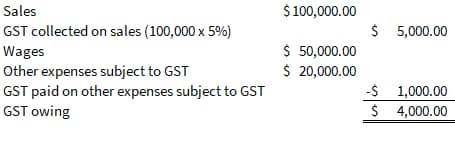
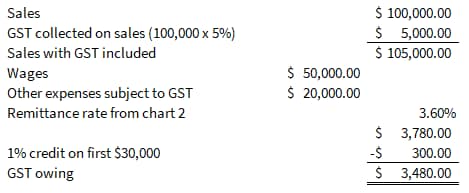
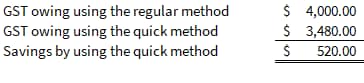
The quick method can be beneficial to businesses that have wages as a large percentage of their expenses since wages are not subject to GST/HST. The following is a basic example to show the difference between using the regular method and quick method of GST/HST.
We assume that the business has a permanent establishment in a province with GST and provides services in that province only.
Visit our bookkeeping services and plans pages to learn more about how we can assist you in reaching your goals. They provide an overview of our services, including information on the benefits and features of each. Feel free to contact us if you have any questions about our services.
Disclaimer
The author takes reasonable care to make sure the information on this blog is complete at the time it was posted. The information may not be comprehensive or current and is provided for general information purposes only.
This blog is not meant to be used as an alternative to professional advice. You should always consult with a professional to obtain advice on your specific situation.